
Industrial Restoration in Pasco
24/7 industrial restoration in Pasco and surrounding areas. IICRC-certified, insurance billing accepted. Call +15095281166.
Industrial water or fire damage shutting down your Pasco facility? We answer 24/7. A pipe failure in a cold storage warehouse, a sprinkler head that triggers over a production line, or a motor fire in a processing plant does not wait for a convenient time, and every hour a facility stays offline costs more than the damage itself. Industrial losses behave differently than residential ones: larger volumes of water, taller ceilings and mezzanines that change drying math, and equipment, inventory, or raw product that can be destroyed faster than drywall.
What industrial restoration actually involves
Industrial restoration covers the structural and equipment-related damage that happens inside warehouses, manufacturing plants, food and beverage processing facilities, and distribution centers, the kind of buildings common around Pasco’s industrial corridors near the port and rail lines. The work scales up from residential methods but the physics stay the same: water migrates into concrete, block, and insulated metal panel assemblies; smoke and soot settle differently across open-span ceilings, ductwork, and machinery than they do in a house. A warehouse flood might mean thousands of square feet of slab-on-grade concrete holding moisture for weeks if it isn’t extracted and monitored correctly. A plant fire often means soot inside motor housings, conveyor systems, and HVAC runs long after visible char is gone. Timelines run longer than residential jobs, sometimes weeks rather than days, because structural assemblies are thicker and production schedules dictate what can be worked on first.
Our process
- Facility assessment and hazard check. Before any equipment goes in, we walk the affected area with facility management to identify electrical hazards, chemical storage, and any OSHA-relevant conditions specific to that operation.
- Bulk water extraction or soot/smoke scoping. For water losses, high-capacity pumps and truck-mount extraction clear standing water from slab and sub-slab conditions. For fire losses, we characterize the soot type and map how far smoke traveled through ductwork and open structure.
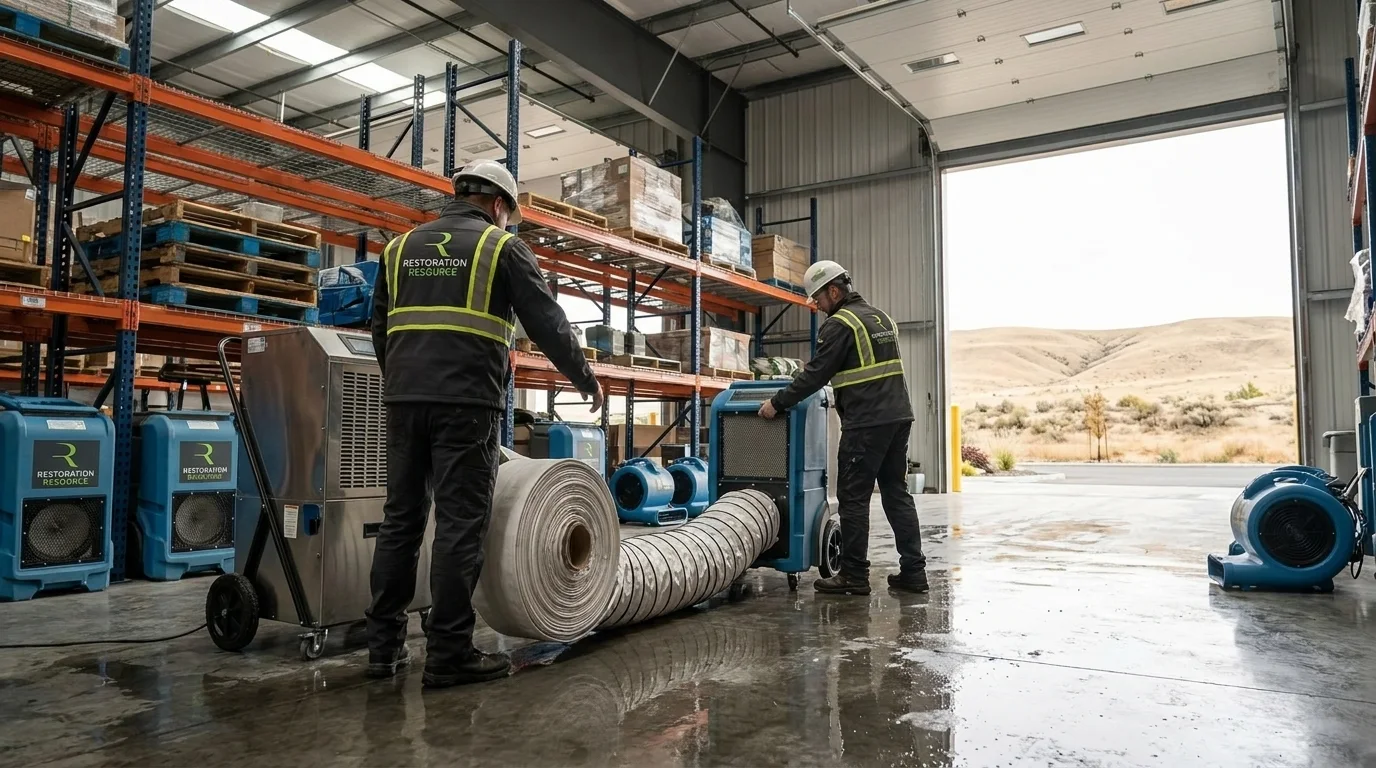
- Industrial-scale drying or surface remediation. Desiccant dehumidification and high-velocity air movers are sized to the cubic footage of the space, not a single room, with moisture monitored daily in concrete, block, and any insulated panel cavities.
- Equipment and contents protection. Machinery, electrical panels, and inventory get cleaned, sealed, or relocated depending on exposure, often in coordination with the facility’s own maintenance team so production equipment isn’t compromised by corrosion or residue.
- Documentation and release for operations. Moisture readings, drying logs, and photos are compiled into a report that supports the insurance claim and gives facility managers a clear record of when each zone was safe to bring back online.
What separates a good industrial restoration response from a bad one
The most common mistake on industrial jobs is treating them like oversized residential ones, pulling visible water and calling it dry without accounting for how much longer moisture lingers in concrete, CMU block, or insulated metal panels. A rushed job leaves secondary damage: corrosion on steel framing, delamination in panel insulation, or mold establishing inside wall cavities that won’t show up until a tenant complains months later. On the fire side, a common miss is cleaning visible soot off surfaces while leaving residue inside motor housings, conduit, and HVAC systems, where it continues to cause odor and corrosion. Adjusters reviewing industrial claims look for daily moisture logs across multiple reference points, clear documentation of what equipment or inventory was affected and why, and a drying plan that accounts for the building’s actual construction, not a generic template.
What does industrial restoration cost?
Industrial losses vary enormously depending on square footage, construction type, and whether production equipment or inventory is involved, so typical industry ranges are wide and every loss gets a written scope before work begins. Homeowners insurance does not apply here; commercial property policies typically cover the restoration work itself, and business interruption coverage, where it exists, may offset downtime costs, though coverage details depend on the specific policy.
| Scenario | Typical range |
|---|---|
| Small warehouse section, clean water, under 5,000 sq ft | $8,000 - $20,000 |
| Mid-size plant floor, water extraction and structural drying | $20,000 - $75,000 |
| Cold storage or food processing facility, contamination concerns | $30,000 - $100,000+ |
| Localized fire, machinery and soot remediation | $15,000 - $50,000 |
| Large-scale plant fire with structural and contents loss | $75,000 - $250,000+ |
Seasonal & regional considerations
Pasco’s summer heat accelerates evaporation but also pushes HVAC and refrigeration systems harder, so mechanical failures and condensation-related losses tend to cluster in July and August. Winter brings freeze risk for exposed piping and sprinkler systems in unheated warehouse sections, a recurring issue in older metal-building stock around the Tri-Cities industrial areas. The region’s low humidity generally works in a facility’s favor during drying, but large open-span buildings still require industrial dehumidification to reach target moisture content in concrete and masonry within a reasonable timeline.
Service area
We respond to industrial and commercial facilities throughout Pasco and the surrounding Tri-Cities area, including Kennewick, Richland, Burbank, and Finley, covering warehouses, manufacturing plants, and processing facilities along the region’s industrial corridors.
If your facility has standing water, smoke damage, or equipment exposure, get a written industrial restoration scope started before the damage spreads further into the building envelope or production systems.
Frequently Asked Questions
Does commercial property insurance cover industrial water or fire damage restoration?
Can a warehouse or plant stay partially operational during restoration work?
What safety protocols apply during industrial restoration in an active facility?
How is industrial-scale drying different from residential drying equipment?
Why does soot behave differently in a manufacturing environment than in a house?
Looking for the best industrial restoration company in Pasco?
Restoration Resource provides licensed and insured industrial restoration in Pasco, WA and the surrounding area, and has served local property owners since 2022. Customers rate us 5.0 out of 5 stars across 38 Google reviews. We answer calls 24/7 — call +15095281166 for immediate help.
Need Industrial Restoration now?
We respond 24/7 across Pasco and surrounding WA cities.