
24/7 Emergency Water Cleanup in Mesa
24/7 emergency water cleanup in Mesa, WA. IICRC-certified, insurance billing accepted. Call +15095281166.
Our IICRC-certified technicians are dispatched from our Pasco, WA headquarters and are typically on-site in Mesa within 60 minutes of your call.
Water damage emergency in Mesa? Call Restoration Resource now at (509) 528-1166 and we answer 24/7. A burst line under a farmhouse kitchen or a sump failure in a Columbia Basin crawlspace doesn’t wait for business hours, and in a small agricultural town like Mesa, standing water left overnight can soak into old subfloor and lath faster than most homeowners expect.
Mesa sits in the irrigated farmland of Franklin County along SR-17, and that geography shapes how water damage actually behaves here. Many properties run on private wells and septic systems rather than municipal water and sewer, which changes the first move on a cleanup call: before extraction starts, our crew locates the well pump shutoff or pressure tank, since a cracked supply line can keep feeding water into a structure long after a homeowner thinks they’ve stopped it. The region’s irrigation infrastruction, pivots, canals, and drain ditches that run close to older farmhouses, also means saturated soil around a foundation isn’t unusual, especially during the growing season when fields nearby are being watered heavily.
Why Mesa Properties See Water Cleanup Emergencies
Eastern Washington’s high desert climate means Mesa gets long dry stretches punctuated by sudden, intense summer thunderstorms that drop more rain in an hour than the ground can absorb. Combined with irrigation runoff and a water table that rises seasonally near cultivated land, crawlspaces and basements in the area can take on moisture even when there’s no obvious interior plumbing failure. Add in the age of some of Mesa’s original farmhouse stock, built with minimal vapor barriers and shallow foundations, and a slow seep can go unnoticed until flooring starts to cup or a musty smell shows up in a back bedroom.
Our Emergency Water Cleanup Process in Mesa
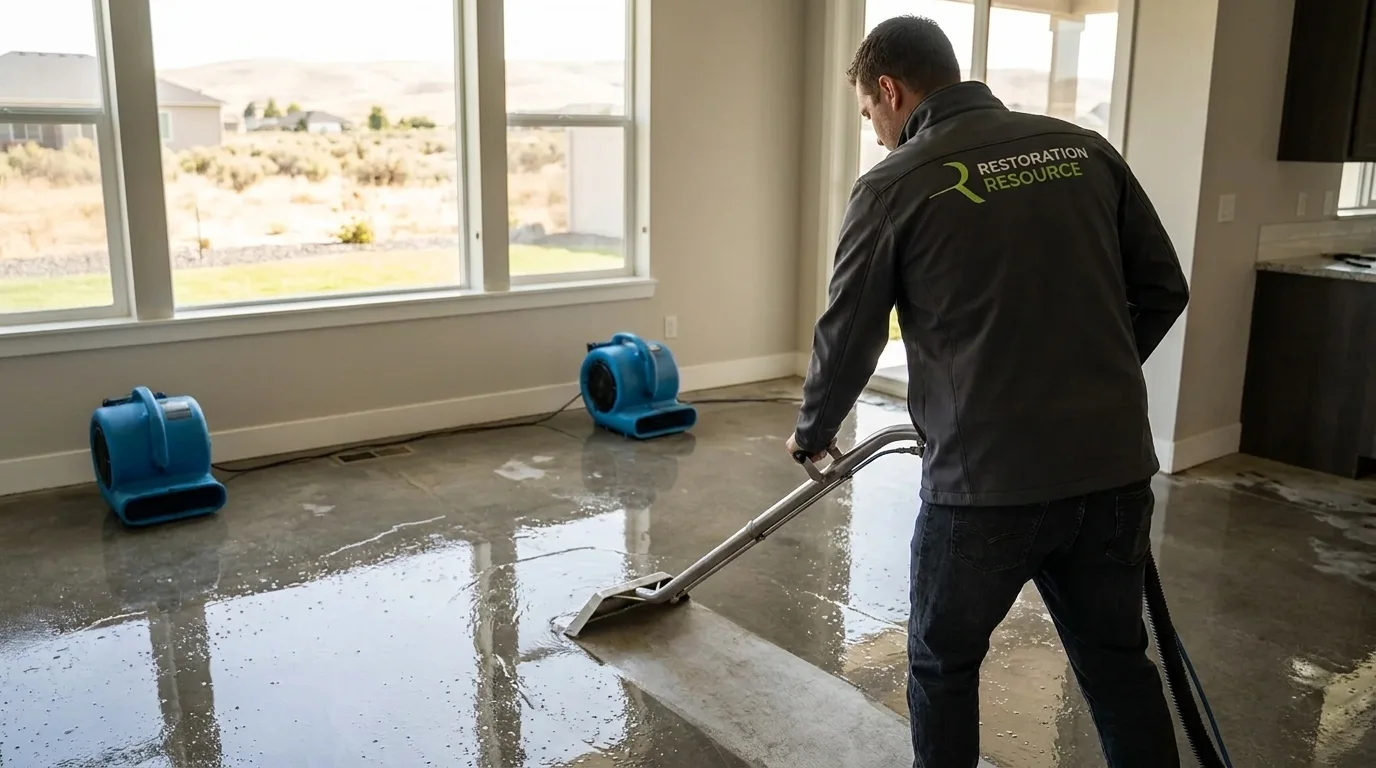
Once we’re on site, the first priority is identifying the water source and shutting it off at the well pump, pressure tank, or main shutoff, whichever applies to the property. From there we extract standing water with truck-mounted or portable extraction units, pull back affected baseboards and flooring where needed to check subfloor moisture, and set containment if the loss is isolated to one area. Drying follows the IICRC S500 standard: we place air movers and dehumidifiers based on moisture readings, not guesswork, and we document those readings throughout the job since that record matters for both drying verification and insurance claims. Our technicians hold IICRC WRT and ASD training, so the drying plan accounts for how differently plaster, old-growth lumber subfloor, and modern drywall each release moisture.
Reaching Mesa from Pasco
We’re based in Pasco, and Mesa is a straightforward run up SR-17 through the Basin’s farm corridor. Because wells, septic fields, and sometimes shared field access roads can complicate where a drying rig or extraction trailer can actually park, we call ahead to confirm access before rolling out, particularly for properties set back from the highway on gravel drives. That one phone call saves time once we’re on the property and ready to work.
Mesa Insurance Coordination
Rural and agricultural properties sometimes carry farm or ranch policies rather than standard homeowner’s insurance, and those policies can have different documentation requirements for water losses, especially when a well or septic system is involved. We photograph the source of the loss, moisture readings, and affected materials as we go, and we can work directly with most major carriers to keep the claims process moving instead of leaving a property owner to piece it together after the fact.
Local note
On properties running private wells, a pressure tank that keeps cycling after a pipe break can mask how much water has actually been lost, since the pump doesn’t know the line is open. We’ve learned to check the pressure tank gauge and well switch as a first step on Mesa calls, not an afterthought, because skipping it can mean water keeps flowing into a structure during the time it takes to set up extraction equipment.
If water is spreading through a Mesa property right now, don’t wait on it. Restoration Resource answers 24/7, and getting ahead of a well-fed leak or storm-driven seep early is what keeps a cleanup job small instead of turning into a full structural dry-out.
Serving Mesa from our Pasco headquarters — ★ 5.0 · 38 Google reviews
“I had a great experience working with this company, Logan in particular. I needed their services to fulfill a real estate contract obligation in Richland, Wa. They were professional, responsive, and timely throughout the entire process. The work was completed within a short timeframe, which was…” — Raeanne, September 2026Read our reviews on Google →
Emergency Water Cleanup in Mesa: Service Coverage
Frequently Asked Questions
How fast can you arrive for emergency water cleanup in Mesa?
How does a private well affect an emergency water cleanup response in Mesa?
Are older Mesa farmhouses more prone to water damage during summer storms?
Can your crew get equipment to properties off SR-17 with limited access?
What's different about drying a Mesa home with a crawlspace versus a basement?
Will my farm or ranch insurance policy cover emergency water cleanup in Mesa?
Emergency Water Cleanup response in Mesa
Most Mesa calls see a technician on-site within 60 minutes from our Pasco headquarters.